
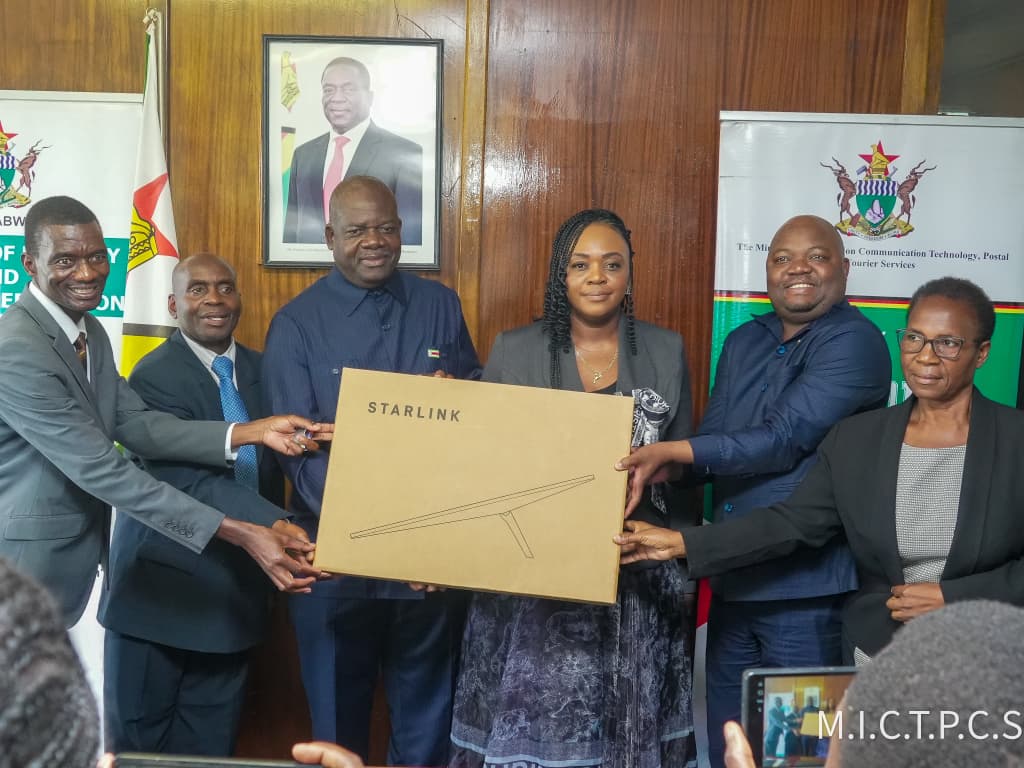
The Ministry of Primary and Secondary Education has received the first 100 Starlink internet kits as part of a major government push to bring high-speed digital connectivity to schools across Zimbabwe. The equipment was handed over by the Minister of Information, Communication Technology, Postal and Courier Services, Hon. Tatenda Mavetera, to the Minister of Primary and Secondary Education, Hon. Prof. Torerayi Moyo, in Harare.
Professor Moyo described the donation as a significant leap forward in the country’s commitment to modernizing education. He stated that the introduction of these kits would revolutionize the way students conduct research and connect with educators, regardless of their geographical location. The Minister emphasized that in the current fast-paced world, reliable internet access is a necessity for growth rather than a luxury, and these tools will ensure that students are better prepared for the global economy.
The 100 kits represent the initial batch of a much larger initiative. President Emmerson Mnangagwa has secured a total of 8,000 kits to ensure that every school in Zimbabwe is eventually connected to the internet. This program is being rolled out through a collaborative “whole-of-government” approach, involving the solarization of rural schools and a national computerization drive to bridge the digital gap between urban and rural learners.
The arrival of this technology is also central to the implementation of the National Development Strategy 2 and the country’s new heritage-based curriculum. By providing stable internet, the government aims to strengthen Science, Technology, Engineering, and Mathematics (STEM) subjects while introducing advanced topics such as Artificial Intelligence, coding, and robotics. This support is particularly vital for the current group of candidates who will be the first to sit for examinations ranging from Grade 7 to A-Level under the new educational framework.
Professor Moyo concluded by assured his colleague and the nation at large that the kits would be utilized to their fullest potential to ensure no child is left behind in the digital era. He noted that the integration of these tools into classrooms is an investment in the future of the nation, helping to foster innovation and excellence among all Zimbabwean children.
